You are currently logged-out. You can log-in or create an account to see more talks, save favorites, and more. more info
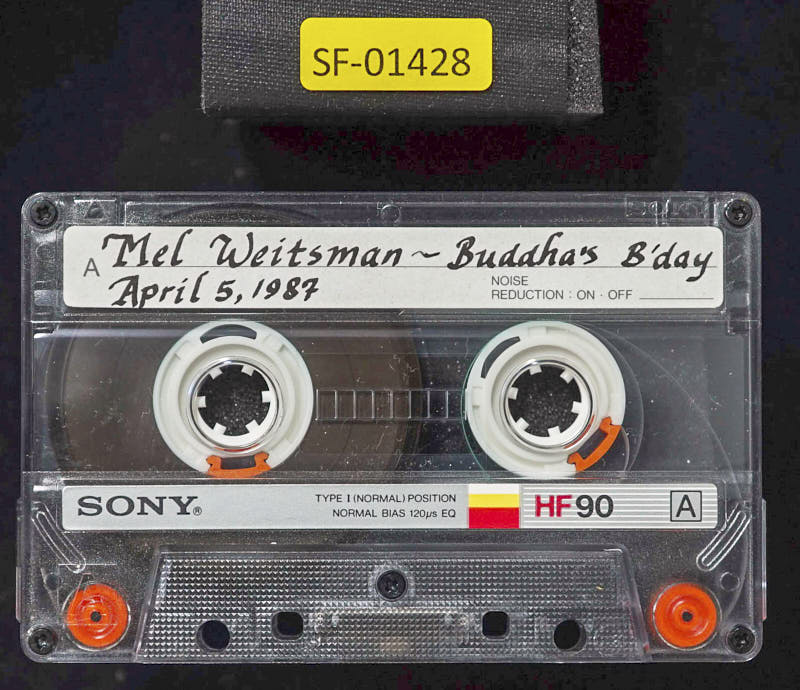
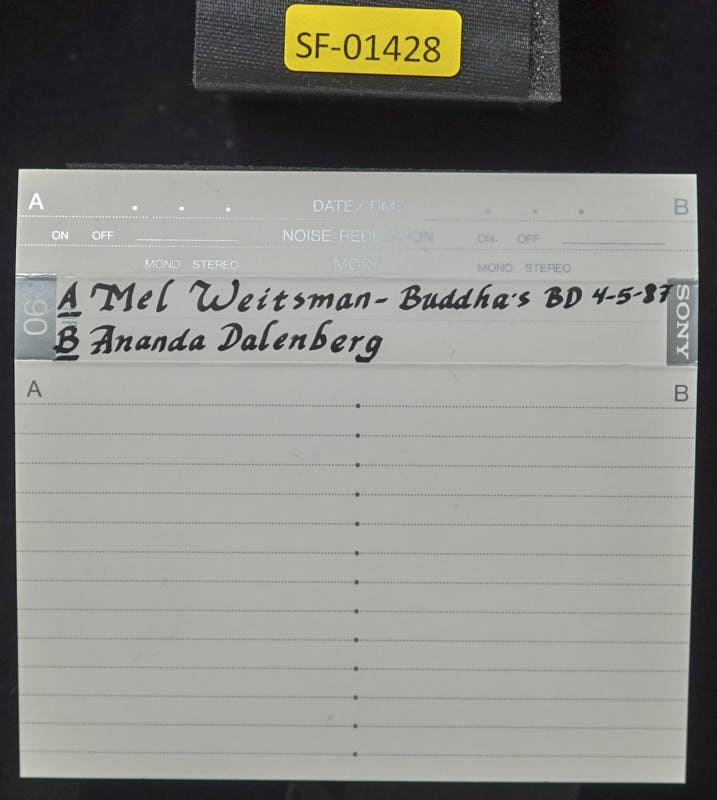
Buddha’s Birthday
AI Suggested Keywords:
The talk focuses on the celebration of Buddha's birth and its symbolism, emphasizing the understanding of enlightenment as an inherent quality available to all individuals. It contrasts historical and personal interpretations of Buddha, identifying the principle of wholeness in Buddha's teachings as embracing both perfection and imperfection. The discourse explores themes of enlightenment as beginning with emptiness, supported by the Zen practice of Zazen, where enlightenment is not a distant goal but a present reality to be realized through directly experiencing life without preconceived ideas.
- The birth of Shakyamuni Buddha is recounted, emphasizing legendary elements such as auspicious signs and symbolism, including the elephant as a symbol of steadiness and understanding.
- The statement "I alone am holy" is analyzed to convey oneness rather than egotism, redefining 'alone' as being at one with everything.
- The Zen Buddha mind school is discussed, suggesting that each person embodies Buddha's qualities and can realize their true nature through practice.
- The story of the affluent prince's journey to understanding suffering and his eventual enlightenment under the Bodhi tree exemplifies the balance between asceticism and indulgence.
- The importance of Zazen is highlighted as a practice where sitting itself is an expression of enlightenment, promoting the idea that enlightenment is found not by seeking but by being still and seeing clearly.
Referenced Works:
- No specific texts or works are directly referenced in the talk. However, it discusses the Buddha's enlightenment and associated legends which are foundational teachings in Buddhist literature.
- The Zen concept of 'Zazen' is a key aspect of the talk and is an established practice in Zen Buddhism, utilized as a pathway to experience enlightenment.
AI Suggested Title: "Inherent Enlightenment: Embracing Wholeness"

#BZ-round3
#duplicate-please-hide
is we commemorate Buddha's birthday. Actually, in our Japanese tradition, it falls on the 8th, April 8th, but we usually celebrate it on the day when everybody's around. In Theravada tradition, they celebrate Buddha's birthday, Buddha's enlightenment, and Buddha's power nirvana on the same day, all three ceremonies at once. But our particular tradition, we separate each one of those and celebrate it on a different day. scholars disagree as to exactly when Shakyamuni Buddha was born.
[01:06]
Pretty hard to pinpoint a day at a time, 2,500 years into antiquity. So something like 2,476, 2,500 or something like that. Pretty long time ago. And there are several legends about Buddha's birthday, about Buddha's birth, none of which I want to talk about. If you're born in a Buddhist country, Legend has some kind of, more kind of meaning for you, I think.
[02:11]
I think in America, maybe the legends sound too fantastic or too colorful. But according to the legend, most legends agree on, that it was a very auspicious time in the world. The world had a lot of problems at the time. And when the world has a lot of problems, people are anxious to have some enlightenment and to look for someone who has some enlightenment. some kind of leader, leadership in a difficult time. So when Buddha was born, it was a difficult time for people.
[03:18]
And there were many auspicious signs pointing to the birth of some wonderful leader, spiritual leader. His mother, Buddha's mother, always dreamt about an elephant. And we don't have elephants here in America except in the zoo. But in India, the elephant is a very powerful symbol and actually remains as the symbol of Buddhism. There's the elephant, the horse, and the rabbit, three symbols of depth of understanding of our life. But the rabbit runs over very quickly without hardly touching the ground.
[04:25]
And the horse runs touching the ground but his feet also leave the ground as he's moving. The elephant takes very steady steps, very heavy, very steady. And each step is a very solid foundation, maybe like a tree or a pillar. So the elephant is considered a symbol of Buddhism. because it's very steady, cheerful, and not given to flames or attachment. So his mother, Queen Maya, dreamt of an elephant, and then she found out that she was pregnant.
[05:32]
and little baby Buddha, sometimes referred to as little baby elephant. And when he was born in the grove at Lubini, it was a very joyous occasion. Lots of flowers and birds singing. The weather was beautiful and just like today, actually, very much like today. And Buddha's birth also comes in the spring, you know, when there's a feeling of renewal, feeling of a new beginning. And one legend says that when Buddha was born, unlike most children, he took seven steps and turned to the four directions and put his hands like this, one hand pointing to the heavens and the other hand pointing to the earth.
[06:48]
And he said, below the heavens and above the earth, I alone am holy, or I am, I alone am holy. Sounds egotistical. But this is, the harder of Buddhist understanding is in this statement. And the key word is alone. I alone. Usually, we think of alone as being detached. But the root of alone, if you look it up in etymological dictionary, they refer you to the word one.
[07:54]
And... The meaning of alone is at one. So, in an egotistical sense, if you say, I am alone, it means I am detached from everything. But in a non-dual sense, alone means not separate from anything. or completely at one with everything. So this statement of baby Buddha, I alone, means I at one with everything, am the holy one. When we have our ceremony, Buddhist ceremony, Buddha's birthday ceremony, there's a little baby Buddha in it covered with a canopy and there are flowers all over the canopy.
[09:19]
And baby Buddha has one hand pointing up and one hand pointing to the earth. And during the ceremony, we offer incense to baby Buddha as welcoming. And then we pour sweet tea over the Buddha. That's very traditional. I think in Japan, there's a certain flower that they use for the sweet tea, but I don't know what we use here. Sometimes I use red zinger. So the feeling is a kind of a welcoming ceremony.
[10:22]
And when we have our meal chant, The old meal chant says, talks about the innumerable Shakyamuni Nirmanakaya Buddhas. Innumerable means each person is Shakyamuni Buddha. And each one of us is that little baby. So what do we... There are two ways, two understandings of Buddha. One is there is a historical person who was born 2,500 years ago. He lived in India near the border of Nepal and was born into the Shakya clan and grew up and came to the Great Enlightenment.
[11:30]
And the other understanding, the complementary understanding, is that each one of us is the Shakyamuni Nirmanakaya Buddha. Buddha is not a god. And Buddhism, although it is a religion, It's really, as someone said, the condition of our mind. So each one of us has the opportunity to come into our own inheritance as Buddha. when we come home to ourself, we inherit ourself, our true nature, or our Buddha mind understanding.
[12:45]
So sometimes the Zen school is called the Buddha mind school of Buddhism. To understand that each one of us has the ability to perfect ourselves. Sometimes when I say perfect ourselves, that could be misleading. Sometimes we say we take refuge in Buddha as the perfect teacher. But perfect includes, it is a word which in its non-dual sense, includes perfection and imperfection. If we want to be perfect, or if we think that by becoming Buddha we'll be perfect, and that that perfect means no imperfection, then no matter how hard we try, we'll always be discouraged, because in a dualistic sense,
[14:05]
We're never perfect. So when little baby Buddha raises his hand to the heavens and to the earth, it's a visual connection with the whole universe. Touching here and touching there means that his fingers meet someplace. in full circle, which includes all the good things in the universe and all bad things in the universe, in perfection. Everything is included in Buddha's perfection. One of the problems that we have in our religious life is that we try to separate out the good part from the bad part of our lives.
[15:36]
Religion shows us a path to goodness and to meeting a pure life. And no matter how hard we try, we can never quite make the ideal life for ourselves. So religion is always a little bit ahead of us. You know, our ideal life is always more than we can actually meet. And the more we try to create an idealistic life based on purity, the further we go away from it.
[16:45]
And we will try almost anything and get ourselves into various situations trying to create a life of purity that's always falling short of possibility. until we come to realize that our life is one whole piece. Our shortcomings and difficulties and the problems and the things that we dislike about ourselves are all part of our life. All part of the purity of our life. In Buddhism, there are various tendencies. And in a certain style of Buddhism, there's a tendency to separate out, to eliminate all the bad part of our life, and just let the good part stand out.
[17:55]
In our Zen practice, Our life doesn't work unless we include and recognize and accept our whole self completely, good and bad, right and wrong, ideal and actual, all together. So instead of trying to get rid of the so-called bad side of our life, offering our mundane existence to our practice. And include everything in our life, in the realm of reality. If you try to eliminate, always get rid of the bad part, you're constantly making a value judgment.
[19:10]
about right and wrong, good and bad. Good and bad do exist. There's a right way to do something and a wrong way to do something. But to be able to accept ourselves completely as we are and see ourselves completely as we are, just to see everything in the light of reality as it is, is the first step of enlightenment, Buddha's enlightenment. So little baby Buddha steps forward right away and he says, holy, saying everything completely as it is. Without leaving anything out, I am complete. But in order to find that completeness, we have to let go of our idea about things.
[20:28]
So first, the first entrance into Zen, is to completely let go of all of your opinions and ideas in order to see everything, to see things as they are, really. Our ideas are always very partial. There's a story about a man who went to see a Zen master in Japan, and he was a university professor And he went to the Zen master and had an interview. And the Zen master was pouring him tea. And he had the cup in front of him and he was pouring the tea.
[21:33]
And he just kept on pouring. At a certain point, you know, tea kept rising higher and higher in the cup. But the Zen master just kept pouring the tea and pretty soon would start overflowing the cup. The visitor was rather alarmed, and he said, can't you see that the cup is full and no more will go in? And the minister said, just like this cup, your mind is so full of yourself that nothing will go in. So the task or the necessary entrance point is to be like a baby Buddha, with nothing in your mind, no opinions, no ideas, to just
[22:48]
have nothing, then you can begin to see again. So a Buddhist is kind of like a born-again person. Actually, to study Buddhism or to study Zen is actually to let go of your knowledge and understanding. And to be completely empty and start again. To see everything in a completely whole way. And it's maybe the most difficult thing to do. As a matter of fact, it's called enlightenment. And it's usually the end of practice. But it's actually the beginning of practice. style of practice, we start from enlightenment.
[23:57]
Our practice starts from enlightenment. Rather than starting from delusion and gradually gaining enlightenment, we start from nothing. So, the entrance point is nothing. No thought, no idea, no opinions. Just emptying your mind, emptying your body and mind. And that's why Zazen is such an important part of our practice. Because in Zazen, we leave everything behind. You know, Buddhism is called the left home leaving home means in Buddhist time people would actually leave home and become monks and give up the world in our time it's pretty hard to do but in a sense we do leave home without leaving home without going anywhere
[25:23]
Leaving home means giving up everything that you depend on as opinions and understanding and views and just see everything completely new and whole. When you see the whole universe in its entirety there can't be anything else in your mind. You can't have some idea about it in your mind. So, Shakti Muni Buddha, as he grew older, discovered, his father kept him very well protected because there was a prediction that he was going to become, that he might be a monk.
[26:40]
He might be a Reiklus. And his father was a very wealthy Raja. And he didn't want his son to do that. He wanted him to inherit his kingdom. And to be a worldly person. And so he kept him very secluded, didn't show him anything, any of the suffering of the world, wouldn't let him look at the suffering of the world. And he was surrounded by entertainers all the time, dancing girls and wonderful kinds of entertainment to keep his mind centered in the palace. But one day, Buddha walked out of the palace, and he saw a dead person, a sick person, dead, old person, and a monk.
[27:50]
And he investigated. He'd never seen anything like this before. He'd never heard of death. He'd never heard of, seen anybody that was sick. And he'd never, he wasn't familiar with old people, with what happens during old age. And he needed to investigate these. So one day he left and became the mother that he saw. And became an ascetic. and did all the ascetic practices. He got down to where he was eating one grain of rice a day and fasting for months at a time. And his body was, he never washed. His body was caked with dirt, like a potato. He'd dig it out on the ground.
[28:57]
people would come by and defecate on him. That was the extreme, he was called the extreme ascetic. And then one day, he realized that asceticism was not the way. There was a middle way between asceticism and indulgence. But still, Buddhism tends to, has an ascetic edge to it, even though it's not considered asceticism, it does have an ascetic edge, which is lean rather than fat, you might say. Buddhism is always on the lean side of things, rather than on the fat side.
[30:05]
So we say, to have warm feet and a cool head. Not a hot head, not a heated up head. Always bring it down to a nice cool temperature so that we don't get into trouble. And when Buddha had his finally had enlightenment. It was when he decided, he sat down under a tree. And he said, I'm just gonna stay here until I get enlightened. And then he crossed my legs, stay here until I get enlightened. And he did. So, cross-legged sitting has always been
[31:08]
central part of Buddhist practice. And we, some people in Buddhism, sit in order to be enlightened, but our understanding is more that because we're enlightened, we sit. Rather than seeking enlightenment through sitting, sitting is an expression of our realization rather than seeking of it. So the seeking and the expression are bound up with each other. So in a sense, we're always seeking enlightenment. But in the same sense, the seeking is the enlightenment itself. So each step is realization.
[32:11]
at the same time is seeking. So when you stop seeking, maybe there's no realization. But at the same time, if you don't see the realization within the seeking, then you're always looking for something beyond where you are. So the important point in sitting zazen is to realize that it's right here, that there's no place to go to find it. And you don't have to do something. You don't have to go someplace special to find enlightenment. If you just stop where you are and look at yourself,
[33:15]
you can see clearly. You have the opportunity to see clearly. So when we're always running, pretty hard to see. It's like the water, when it's always turbulent, it's hard to see through. but when the water, you calm the water and it's very still, then you can see all the way to the bottom. So when we sit in Zazen very still, we don't think about something special. It's just like baby Buddha putting one finger, one hand up and one hand down.
[34:21]
Sitting in Zazen, just like that. Without anything in your mind to just be connected to the heaven and the earth. To just realize who we are. without any idea interfering, just direct experience. All of us are sitting here right now, just directly experiencing ourselves. It's quite wonderful. Each one of us is baby Buddha, whether we know it or not.
[35:31]
Just experiencing ourselves in our completeness, wholeness. Nothing to add and nothing to take away. Breath is just coming and going. Breath is just hanging out. Just hanging out. Whose breath is it? Whose breathing? Just some great functioning.
[36:36]
So on this day of Buddha's birth, of our birth as Buddha, let's be joyous and happy and let ourselves be free, feel some freedom with each other and with our true nature. Very simply.
[37:48]
@Transcribed_UNK
@Text_v005
@Score_90.49